Building a Cross-Functional Content Workflow Under Pressure
Company: TechSmith (Snagit and Camtasia)
Role: Content Marketing Strategist
Timing: Sept–Oct 2024
TechSmith set a stretch goal to publish 200 new URLs in one month as part of a company-wide SEO push. I turned the chaos into a controlled content assembly line, shipping 200 new and updated pages in 6 weeks while putting quality and SEO guardrails in place that the content team still uses today.
The situation
In Sept 2024, TechSmith launched a company-wide content sprint that was framed as an SEO play: publish a lot, fast. A competitor had a much bigger site footprint, and leadership’s assumption was that more pages would help us compete in organic search.
The goal was 200 URLs in one month. The catch was that the “what” was announced before the “how,” so I had to build the workflow immediately, then channel a ton of well-intentioned help from teams across the company into something shippable and safe.
The challenge: a high-volume content push can work, but only if it’s grounded in search intent and quality. Without that, you risk:
thin or duplicative pages
keyword cannibalization
inconsistent quality and voice
inaccurate product claims
publishing mistakes
and a lot of wasted effort
So I did what I always do in chaos: I built a system.
Constraints
Content bandwidth was tiny: existing copywriting resources were me and a contractor (team had shrunk; roles weren’t refilled).
Cross-functional participation was required: many contributors weren’t trained to write or publish content.
High SEO risk: thin content, duplication, cannibalization, and content created without a clear intent match.
The insight
You can’t teach an entire software company to become writers in a month. But you can build an assembly line where people contribute what they’re best at:
SMEs provide expertise
writers translate expertise into SEO-aware copy
reviewers protect accuracy
publishing has clear QA guardrails
and everyone knows what “done” means
What I did
1) Reframed the goal into something more SEO-realistic
First move: I advocated that part of the goal should be content updates, not only net-new URLs. We already had core-topic pages that needed improvement, and updating often delivers more value than creating new pages purely for volume.
2) Built an SME intake system (so experts could be experts)
For feature-focused landing pages (commercial-intent pages targeting non-brand searches like “remove video background”), I created structured intake forms for product/dev SMEs to supply what matters:
who the feature is for
what problem it solves
why it’s stronger than alternatives
what accuracy constraints we needed to respect
Then this expertise could be translated into successful landing page copy.
3) Aligned the company through simple, memorable training
A big part of making this work wasn’t just the process; it was getting the org aligned on how to collaborate without everyone making random content and tossing it over the fence.
So I ran company-wide presentations introducing the workflow using the French brigade system (I was watching The Bear at the time). Everyone had a station. Handoffs mattered. Quality came from the system, not heroics.
To this day, I still get an occasional “yes chef” when I make a request.
4) Designed an Asana workflow that could survive 7–10 people touching one page
I created a board with clear stages and hand-offs so pages moved forward without getting lost.
Feature page workflow (columns):
Housekeeping → Blocked → Backlog → Product Consult → Copywriting → Copy review → Ready to template → Ready for assignment → Image creation → Image review → Add to WP → Ready for pre-flight → Published → Internal linking
An example of Asana board used during the project.
Mechanics that kept it moving:
Unassign-on-move so the next person could pick it up cleanly
Subtasks per stage to make ownership and status visible
Daily standups to identify bottlenecks and shift resources
We applied the same assembly-line approach for blog production (outline/brief → writing → review → images where needed → WP build → pre-flight → publish), so distributed writing didn’t turn into a pile of unreviewed drafts.
5) Scaled consistently with custom GPT workflows
To move faster without sacrificing structure, I developed a custom GPT workflow that turned SME intake into copy structured for our landing page template (then my writer and I reviewed and refined it).
Because most blog contributors weren't writers, I built another custom GPT workflow that generated SEO-optimized creative briefs for each topic. My contracted writer and I would:
prompt the GPT to generate a structured outline
edit for clarity and accuracy
include key guardrails like target word count, semantic/related terms to include, and the recommended structure
Then writers could focus on filling in content, not inventing a strategy from scratch. This also created consistency across posts despite a wide range of writing styles.
6) Added SEO guardrails with Semrush
To reduce thin and low-quality content and help contributors learn as they go, I used Semrush’s Content Writing Assistant as a quality gate across content types. For approval, the content needed to hit a 9.0+ score for target keywords.
I also maintained a master URL/keyword tracker to reduce keyword cannibalization and keep work aligned.
7) Made WordPress publishing safer with a pre-flight checklist
I collaborated with designers to build a pre-flight checklist so even non-experts could QA in WP (alt text, titles/meta, formatting, layout checks). This checklist is still used today by the content team.
8) Bonus: created a repurposing system
We built a repurposing system to reuse landing page copy and imagery into social carousels/videos, so the work supported channels beyond search and kept earning its keep after launch.
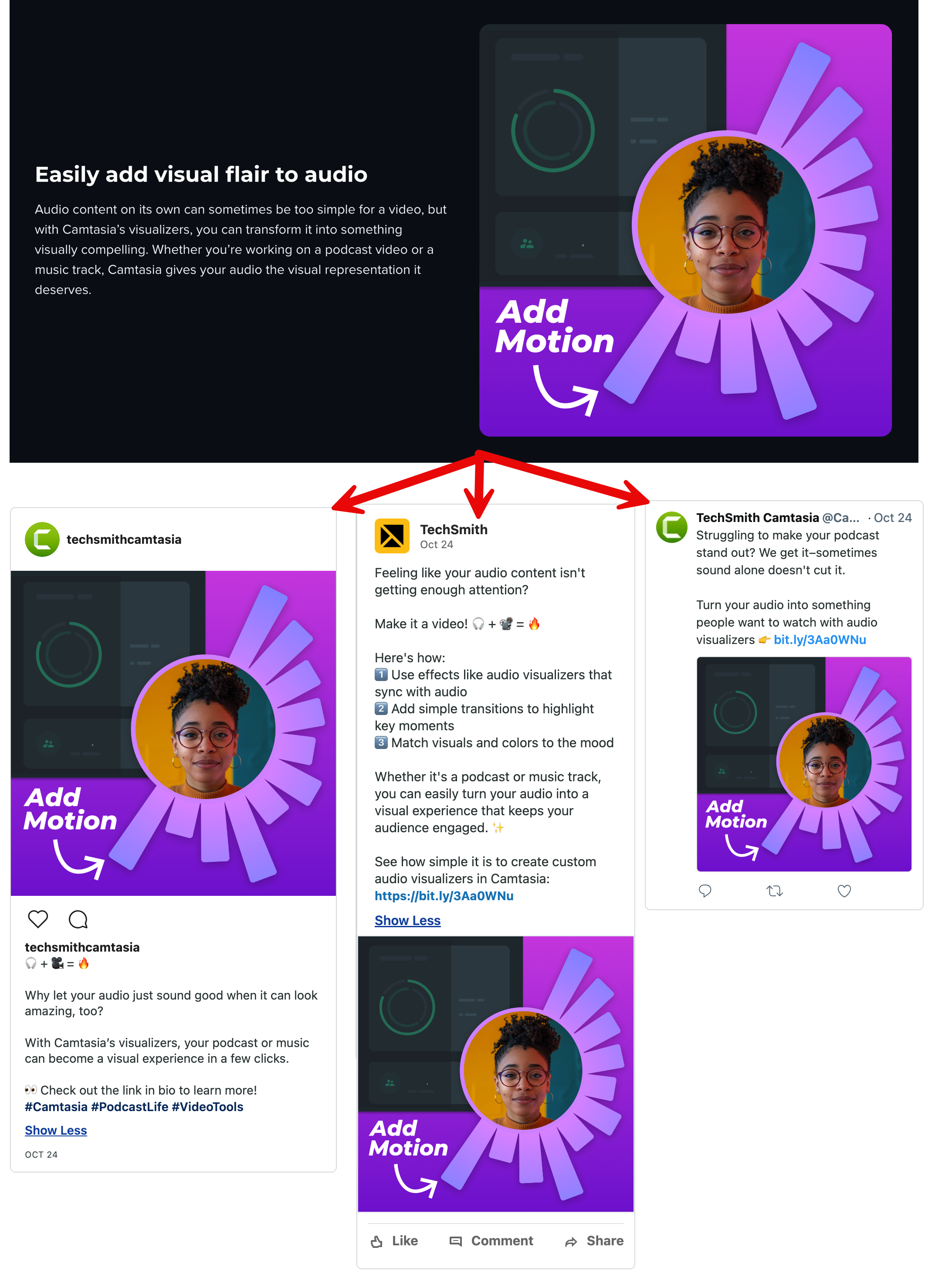
Example of feature page repurposing on social
Results
Published 200 new pages and updates in 6 weeks (against the original 200-in-a-month goal).
We went from landing pages taking weeks (no process) to shipping dozens in a week during the push.
After the push, the marketing team kept the system and found a healthier speed/quality balance using the same templates and workflows.
We still pull in cross-functional teams for SME input, but they’re no longer expected to write content as a side quest.
What we learned: page count ≠ intent match
This project clarified a strategic reality about search intent and product fit.
Camtasia is a desktop video editor. The competitor we were benchmarking against was a browser-based editor ranking for task-based queries like “crop a video” and “trim a video,” where users can click and complete the job immediately in-browser.
We tested pages for those terms, but we couldn’t satisfy intent as cleanly because desktop download friction is real. In other words, more pages didn’t change the underlying user experience gap.
That learning helped shift internal thinking from “we can content our way into this category” to “some of this is a product strategy question,” and it supported prioritization of a browser-based Camtasia experience for basic workflows.
On a personal level, it reinforced something I know about myself: when the ask is high-pressure, and the path is messy, I don’t freeze or argue in circles. I build structure, protect quality, and make it possible for people to collaborate without stepping on each other.
